Authors (4): J. Kennedy, J. S. Hayward, P. R. Davies, M. Bowker
Themes: New Catalysts DOI: 10.1088/2515-7655/abdd82
Citations: 7
Pub type: article-journal
Pub year: 2021
Publisher: IOP Publishing
Issue: 2
License: [{"URL"=>"https://iopscience.iop.org/page/copyright", "start"=>{"date-parts"=>[[2021, 3, 11]], "date-time"=>"2021-03-11T00:00:00Z", "timestamp"=>1615420800000}, "delay-in-days"=>0, "content-version"=>"vor"}, {"URL"=>"https://iopscience.iop.org/info/page/text-and-data-mining", "start"=>{"date-parts"=>[[2021, 3, 11]], "date-time"=>"2021-03-11T00:00:00Z", "timestamp"=>1615420800000}, "delay-in-days"=>0, "content-version"=>"tdm"}]
Publication date(s): 2021/04/01 (print) 2021/03/11 (online)
Pages: 024007
Volume: 3 Issue: 2
Journal: Journal of Physics: Energy
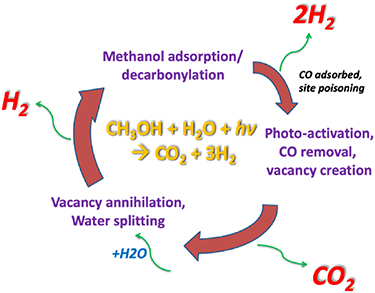
URL: http://dx.doi.org/10.1088/2515-7655/abdd82We have examined the reforming of methanol and CO on Pd/P25 TiO2 catalysts for hydrogen production, and compared it with rates for similarly supported Au and Cu catalysts. Both reactions proceed, but the photocatalytic water–gas shift (WGS) reaction is much slower than for methanol reforming. CO2 is evolved as expected, but the yields can be much lower than for the expected stoichiometry (CH3OH + H2O → CO2 + 3H2). We show that this is due to dissolution of the carbon dioxide into the aqueous phase. We have also carried out both reactions in the gas phase. Both proceed at a higher rate in the gas phase, and for methanol reforming, there is some CO evolution. In H2 + CO2 reactions, there is little sign of the reverse WGS reaction, but some photo-methanation does occur. Of the three catalysts Pd is the best for the methanol reforming reaction, while Au is best for the water–gas shift. Nonetheless, Cu works reasonably well for methanol reforming and makes a much cheaper, earth-abundant catalyst.
There are no objects associated to this publication
<< Previous Back Next >>